

Responsive Neurostimulation (RNS)
At least 30% of people do not respond to anti-seizure medicines. Some people can have surgery to remove where seizures start in the brain, though surgery may not be an option for everyone with uncontrolled seizures. For instance, if seizures originate in an area of the brain that cannot be removed or if seizures originate from more than one region in the brain.
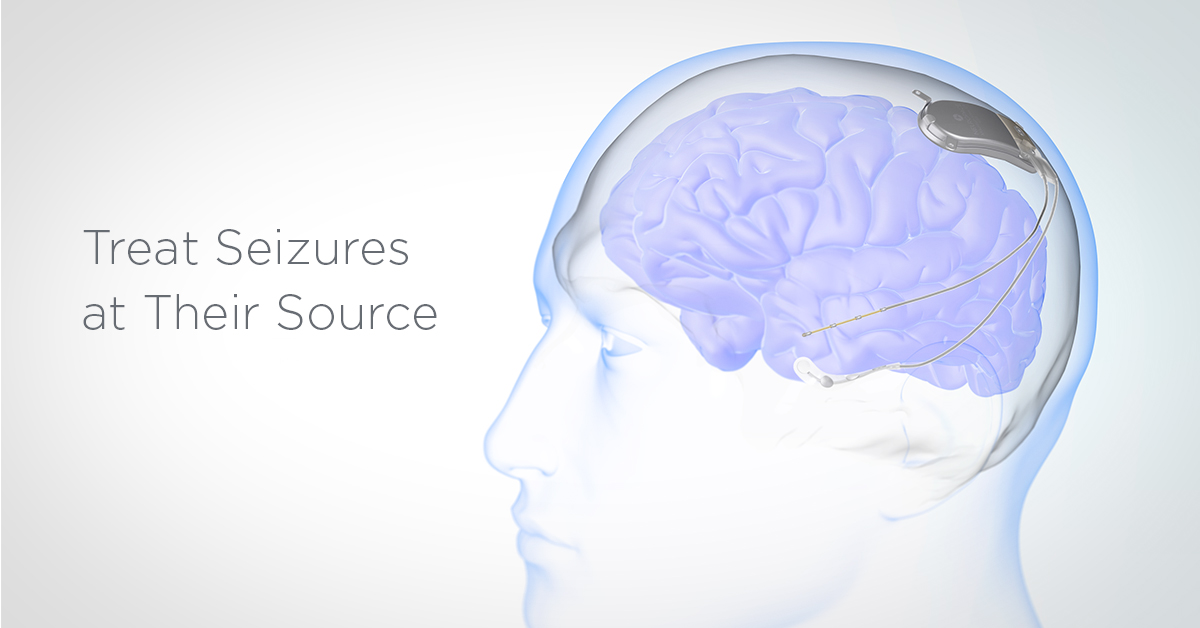 |
| Brain-responsive neurostimulation with the RNS® System. Image Copyright 2017, NeuroPace, Inc. |
One treatment option is the use of responsive neurostimulation. Known as RNS therapy, this type of treatment was approved by the U.S. Food and Drug Administration (FDA) in 2013. Neurostimulation is a type of treatment used in epilepsy that relies on sending very brief electrical currents to certain structures or areas of the brain to interrupt the electrical current of a seizure. Over time, seizure frequency can decrease from RNS therapy.
To be a candidate for RNS therapy, people must first be evaluated to see if they can benefit from treatment with this device, or if other types of neuromodulation therapies may be more appropriate, such as vagus nerve stimulation (VNS) or deep brain stimulation (DBS). Most comprehensive epilepsy centers that provide epilepsy surgery can offer the RNS® System and perform the detailed testing to see where their seizures arise in the brain.
The RNS® System is designed to work in 3 key ways:
- Monitors brain waves at the seizure focus, all the time - even during sleep.
- Detects unusual electrical activity that can lead to a seizure.
- Responds quickly (within milliseconds) to seizure activity by giving small bursts or pulses of stimulation.
What is the RNS® System?
The RNS® System is a device that has a computer chip programmed to identify abnormal electrical activity of the individual and to deliver the electrical current specific to the seizure focus. In other words, the device learns what is going on in each seizure focus, and the settings can be adjusted until the optimal detection of the abnormal activity and the stimulation to stop it are obtained in each person.
- The RNS® System is similar to a heart pacemaker. It monitors brain waves, then responds to abnormal electrical activity that looks like a seizure.
- A device or stimulator is placed in the bone covering the brain. Tiny wires or leads are connected to the device and placed in two places on top of the brain where seizure activity may begin. Once the wires and device are placed, they will be completely covered.
- The system can give small pulses or bursts of stimulation to the brain when it detects abnormal electrical activity that can lead to a seizure. This can stop seizure activity before the actual seizure begins or help prevent subsequent seizures. It could also stop seizure activity from spreading from a small focal seizure to a generalized seizure.
- People cannot feel the stimulation once it’s programmed. It doesn’t cause pain or any unusual feelings.
- The device and the leads can be removed if it doesn’t work or if a person no longer wants to use it.
Factsheet
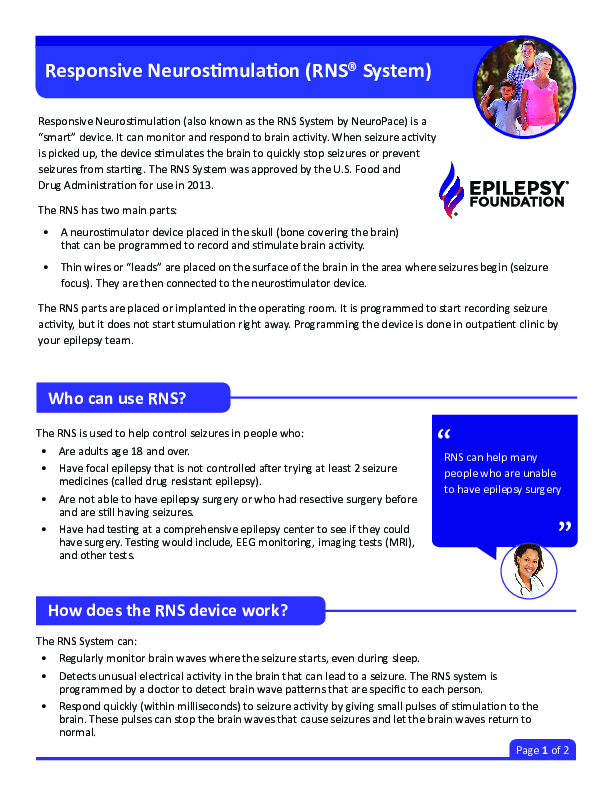
Download this factsheet to learn about who can use RNS and how the device works.
Who Can Use The RNS® System?
- The RNS® System has been approved by the FDA to treat focal seizures in adults 18 years and older.
- It’s used in addition to seizure medications.
- It’s designed for people with drug-resistant epilepsy — meaning a person continues to have seizures despite trials with two seizure medications.
- It’s used in people who cannot have epilepsy surgery to remove where the seizures start, or resective surgery has not worked.
How Does The RNS® System Work?
A device like the RNS® System changes or modulates brain activity to stop or prevent seizures.
The exact way that the RNS® System works is not known. It is thought to act on a certain substance in the brain called an inhibitory neurotransmitter, which inhibits or stops activity from brain cells that could lead to seizures. This may explain how the RNS works in the short term. Its long-term effect may be caused by something else affecting how brain cells work more broadly.
How Helpful Is RNS® Therapy?
Although the RNS® System is not a cure for epilepsy, it has shown to reduce seizures in the majority of people who have used it. So far, these effects appear to improve over time in many people.
Real world retrospective study:
- 130 patients with the RNS® System were followed for an average of 2.3 years. The average decrease in seizures was 67% after 1 year, 75% at 2 years, and up to 82% after 3 or more years of using RNS.
- So far, about 3 out of 4 people with the RNS® System (77%) had their seizures cut in half after 2 years of using it.
- Some people had extended times of being seizure free as well. In the open label study or long-term study, 1 out of 3 people reported periods of no seizures for 6 months in a row.
Quality of Life Results
- Benefits of any therapy must also look at how a person feels and their quality of life.
- A study of 191 people with the RNS® System found improvements in quality of life aside from seizure control. These benefits did not appear due to changes in seizures or medicines. These included:
- Physical health
- Cogntitive functioning (for example thinking, remembering, and concentrating)
- Emotional health or mood
- Less worry about seizures
- Overall quality of life
Resources
The RNS® System is manufactured by NeuroPace, Inc. Additional information for patients and physicians is available at their website neuropace.com.
Resources
Epilepsy Centers
Epilepsy centers provide you with a team of specialists to help you diagnose your epilepsy and explore treatment options.
Epilepsy Medication
Find in-depth information on anti-seizure medications so you know what to ask your doctor.
Epilepsy and Seizures Helpline
Call our Epilepsy and Seizures Helpline and talk with an epilepsy information specialist or submit a question online.
Tools & Resources
Get information, tips, and more to help you manage your epilepsy.
Related Stories


Press Releases
Epilepsy Community Celebrates Senate Passage of the National Plan for Epilepsy Act
Read Story